Phones for kids: the full picture
Every option by age and type, what actually makes one safer, and how to choose for your child.
Read the complete guide to phones for kidsSayph is a phone designed from the ground up for childhood: calls, texts and the real world, without social media, app stores or the open internet.
Built by parents · Gold winner, MadeForMums Tech Awards 2026 · Reviewed by Smartphone Free Childhood
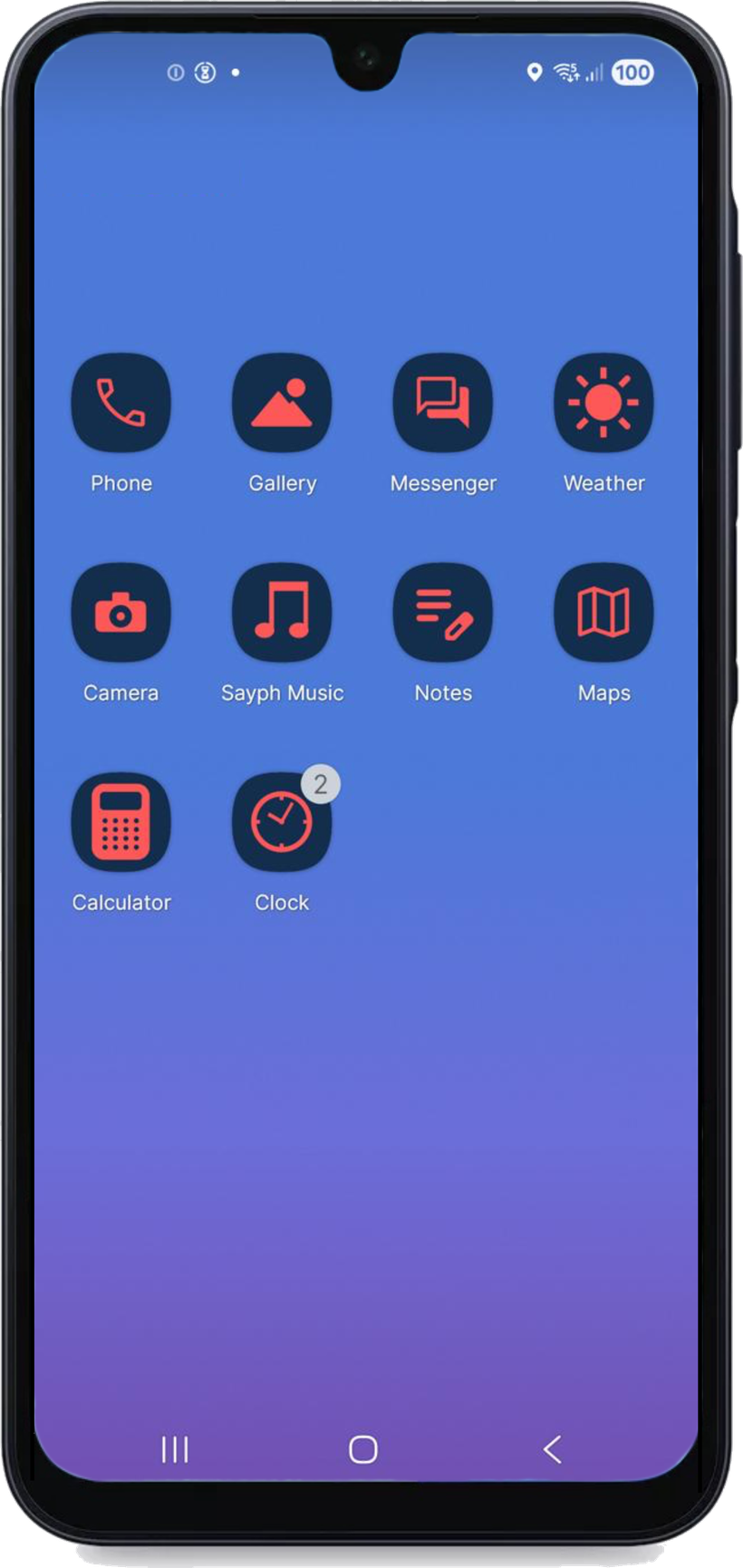
Most phones give children unrestricted access to social media, addictive apps and harmful content. Parental controls are easy to bypass and hard to manage. Sayph is different: not a smartphone with controls bolted on, but a phone built to be safer from the ground up, so you can say yes to a first phone without saying yes to social media. Our safe phone for kids page explains where the safety has to live – in the design, not the settings.
Sayph puts parents in control. No unsafe apps. You decide who they can contact, and set times when the phone works.
Only numbers you approve can call or message this phone. No calls from unknown users.
Nothing risky or addictive, by default. Addictive apps have no place in childhood, but this shouldn't make your child stand out.
Check where they are whenever you need to: on the walk home, at the sleepover, at the match. Peace of mind, on demand.
With no app store, no default browser and parent-only installs, Sayph is much harder to circumvent than standard parental controls.
Select which contacts can exchange photo messages with your child. If unsure, these are blocked by default.
No juggling parental controls. Message summaries are designed to flag anything that may need your attention, so you stay informed without reading every text.
Want to see each app and control up close? How Sayph works walks through the whole phone, app by app.
The straight answers to the worries that usually decide it – no scrolling to the FAQ required.
Sayph is far harder to get around than standard parental controls. There’s no app store, no default browser, and the restrictions are built into the operating system itself – not an app sitting on top of it. There are no settings for a determined child to find and switch off. Only Sayph apps – designed for specific needs, rather than distraction or entertainment – are available.
Read the full answerLeaving WhatsApp off is a deliberate choice. For most children the real risk isn’t strangers – it’s the group chats Ofcom finds are among the most common places children are bullied online. Keeping it off means messaging stays between the contacts you’ve approved and visible to you, rather than routed around everything that makes Sayph safer.
Read the full answer
“Overprotection in the real world and underprotection in the virtual world are the major reasons why children born after 1995 became the anxious generation.”
Getting started with Sayph is straightforward. Here's how it works.
Choose your Sayph phone from our shop. It arrives pre-configured and ready to go with free UK delivery.
Visit the parent portal and create your account. This is where you'll manage everything.
Turn on the Sayph phone and enter the linking code. It connects to your parent portal instantly.
Use the parent portal to add phone numbers your child can contact. Only approved numbers work.
Give your child their independence, and enjoy your peace of mind. Stay in the loop from your portal.
Prefer the detail? See the full walkthrough – the phone and the Sayph Space portal, screen by screen.
Many phones marketed for children still let you add apps. In practice the nagging wears you down, and bit by bit the very apps you wanted to keep off creep back on – with screen-time limits left to do the holding. Sayph is built differently.
On a Sayph phone, third-party apps cannot be added – not by your child, and not by you. There’s nothing to be talked into one app at a time, and no quiet drift towards a full smartphone that simply has a child-protection box ticked. The line stays where you set it.
Sayph is a deliberately simple phone you can keep for as long as it suits your family, not a device that slowly becomes an adult smartphone. When your child is truly ready for more, you decide to move them on, on your terms. We think that’s often around 16 in an ideal world, though every child is different.
AI reports summarise how your child uses their phone, so you stay in the picture without reading everything. The Sayph parent portal gives you full visibility and control, from anywhere.

Objective, evidence-based guides to the first-phone decision – no scare tactics, no hard sell.
Every option by age and type, what actually makes one safer, and how to choose for your child.
Read the complete guide to phones for kidsThere’s no magic number, but there is good evidence – and a practical way to decide.
What age should a child get a phone?A fair look at every option, from basic phones to safer smartphones – ours included.
Find the best first phone for kidsWeighing up a specific brand? See how Sayph compares with other kids’ phones: Sayph vs Pinwheel, Sayph vs HMD Fuse and Sayph vs OtherPhone.
We’re researching how UK families navigate first phones, social media and screen time. It’s short, anonymous and will help to shape what we build.
Take the survey

“We started Sayph because we were standing exactly where you might be standing now. If you’ve agreed with other families to hold the line and wait, Sayph is the phone that lets you keep the promise you made together.”
Hear from parents who've made the switch – and the awards judges and campaigners who’ve put Sayph through its paces.
“The phone is a great hit. We’re foster carers and the social workers are also big fans of how the phone works and helps promote safeguarding.”
“It’s what we were looking for in a child friendly phone – no complicated parental controls and easy to operate.”
“It’s simple to use and keeps kids young and safe while giving them freedom.”
The Sayph phone won the Gold award for ‘Best Child-Friendly Phone’ at the MadeForMums Tech Awards 2026. Testers felt it struck “a great balance between independence and safety” and called it “a brilliant concept” for families navigating a first phone.
More about the awardSayph features in Smartphone Free Childhood’s guide to smartphone alternatives, which calls it “a convincing middle ground for families who want location tracking, messaging and a modern handset without giving their child an open smartphone” and “a strong option for a safe phone device”.
More about the reviewIn good company – the movements we stand with and are inspired by
No hidden fees, no lock-in. Just the phone and a simple monthly subscription.
However, ‘free’ can cost you more in the long run. An old phone can be locked down, but it takes research, constant monitoring, and can often be sidestepped by watching over your shoulder while you enter a PIN.
Everything you need to know about Sayph.
Answered by Ben, co-founder of Sayph.
8 to 16. Like Smartphone Free Childhood, we believe that in an ideal world children wouldn’t need phones at all, and that holding off for as long as you can is the right instinct. But when the time comes for your child to stay in touch and have a little independence, that first phone shouldn’t be an open smartphone. Sayph lets you say yes to calls, texts and knowing where they are, without saying yes to social media, an app store or the open internet.
If you’re weighing up the timing, our guide to what age should a child get a phone walks through the UK evidence, and we look specifically at the best phone for a 10 or 11 year old for the move up to secondary school.
Sayph is built to be far harder to get around than standard parental controls. There’s no app store, no default browser, and the operating system itself is restrictive; there are no settings for a determined child to find and switch off. No device on earth is tamper-proof, but unlike bolt-on controls, Sayph’s restrictions are the phone, not an app running on top of it. Only Sayph apps – designed for specific needs, rather than distraction or entertainment – are available.
No. We've heard too many stories about what happens when children are allowed to roam free on social media, and we don't believe the big tech firms can be trusted to safeguard our children. The tech firms have themselves chosen 13 as the age when they want children to start using their products. We believe if governments were serious about prioritising children's mental health and wellbeing, they would ban social media use before 16.
WhatsApp isn’t available on a Sayph phone, and that’s a deliberate design choice. For most children the real risk on WhatsApp isn’t strangers, it’s other children: group chats where any member can add images, videos and messages, and which Ofcom finds are among the most common places children are bullied online. Add disappearing ‘view once’ messages, content that arrives as images rather than searchable text, and end-to-end encryption that hides what’s being shared, and it quickly becomes a child’s whole social world – with all the pressure, exclusion and fallout that brings.
Allowing it would also undermine the things that make Sayph safer: messaging stays between the contacts you’ve approved, stays visible to you in the Sayph Space portal, and isn’t buried under constant notifications. WhatsApp would route your child’s messaging around all of that. We’d rather keep the phone built for staying in touch, not for growing up online. You can read our full parent guide, ‘WhatsApp & your child’, on our resources page.
There’s no web browser on the Sayph phone, and keeping children off the open internet is a core part of what makes it safer. If we ever do offer a browser, we’ll only do it once we’re confident it can be done safely – that’s our priority, not the timing. And it would never simply appear on your child’s phone: a browser would never be added by default, or slipped on through a software update without you knowing. A parent would always have to actively choose to add it, and you could leave it off entirely.
No, and that’s deliberate. There’s no app store, and apps can’t be downloaded or added on; the phone stays limited to communication and a few necessary extras (like maps and radio) that support children and young people in exploring and enjoying the real world. We believe that’s the most secure approach.
It’s also a deliberate guard against the slippery slope. If a phone can always have ‘just one more app’, it can quietly drift towards social media and end up only delaying the inevitable by a few months, rather than holding the line for several years. Because extra apps simply aren’t available, you can’t be nagged into installing something you don’t want, which we hope takes the heat out of those repeated requests for more. Plenty of phones treat child safety as a tick-box; we want to go further than that.
If you’re still comparing your options, our complete guide to phones for kids weighs up every route, and our best first phone for kids buying guide runs through them one by one.
We believe that safer phones should be available to all children, so have worked hard to keep the costs low. The 4G Sayph Phone is available to buy now for £189. Monthly subscription from £4.99/month. You will just then need a SIM & call plan (available from £2–3/month).
Parents can select which contacts are approved for exchanging MMS (picture messages) with. This is to reduce the risk of children and young people either being sent images they don't want to see, or pressured into sending something they shouldn't. New contacts default to ‘No MMS sharing’ so photos will only be exchanged with people you’ve expressly approved for them.
The Sayph phone works with any standard UK SIM card. You buy the SIM yourself from any provider – Sayph does not sell SIMs. You can use a SIM you already have or pick up a low-cost plan from providers like Smarty, Giffgaff, or Tesco Mobile. The Sayph phone uses a nano-SIM and supports all major UK networks (EE, Three, O2, Vodafone and their MVNOs).
If you live somewhere with patchy mobile reception, it’s worth checking with the provider that your chosen plan supports Wi-Fi Calling (sometimes called VoWiFi) before you commit. This lets the phone make calls and send texts over WiFi when the mobile signal is weak. Most major UK networks support it, but not every low-cost plan does, so it’s worth confirming first.
You can compare low-cost SIM-only plans on independent sites such as MoneySavingExpert, Uswitch and MoneySupermarket. If you think your child may want to send picture messages now or in the future, it’s worth choosing a plan that includes MMS, as not all plans do and it can be costly to add later on some networks. Smarty SIM-only plans, for example, include MMS as standard – though we mention this for information only and it is not a recommendation of any particular provider.
Calls and texts work on any SIM, but live location tracking, remote monitoring and online maps need a mobile data connection to work when your child is away from WiFi. You don’t need a large allowance – only a little data is required – but we’d suggest choosing a plan that includes some, so these features keep working when your child is out and about rather than only updating once the phone reconnects to WiFi.
For a fuller walkthrough – how much data to choose, and which networks include picture messaging and Wi-Fi Calling – see our guide to choosing a SIM.
No, and we’d be suspicious of any product that claimed to. Sayph gives you visibility and control, but it doesn’t monitor your child’s wellbeing in real time and it isn’t an emergency service. It works best alongside the conversations you’re already having. We also encourage you to be open with your child about what the phone shares with you; in our experience, that openness is what builds trust rather than resentment. If you’re ever worried about a child’s immediate safety, call 999.
As little as possible, for as short a time as possible. Messages, call logs and location history are encrypted, visible only to you (never to Sayph staff), and automatically deleted after a maximum of 30 days. We don’t sell data, we don’t profile children, and our AI summary provider is contractually barred from training on your family’s data. Full details in our Privacy Policy.
We’re part of a wider movement helping families navigate phones and screens, and a few publications have written about what we’re building.
As seen in Kin Magazine, My Lemon Magazine & Stuff
Explore resources & pressGive your child the freedom to call, text, and explore the real world, without handing them the digital one.
Like the Smartphone Free Childhood movement, we believe children shouldn’t be handed powerful tech before they’re ready. But when the day does come that your child needs a phone, there shouldn’t be a cliff-edge from no phone straight into the full adult internet. Sayph is the gentle step in between, ready for whenever that day arrives.
We’ll check in nearer the time, plus early-bird perks for list members when you’re ready to buy.

Sayph is a UK company, creating safer phones for children. Our smartphones remove social media, app stores and addictive features, helping reduce screen time and online risks. With a parent-controlled portal, Sayph supports safer independence and healthier digital habits for kids.
Get in Touch